Open any telecom report on Zimbabwe and the headline looks impressive. Internet penetration has climbed above 84 percent. Mobile subscriptions are above 100 percent of the population. Traffic is growing at double-digit rates every quarter. Yet talk to a student in Mutoko, a market trader in Bulawayo, or a small business owner in Gweru and you will hear a different story: data runs out before the month does, video is out of the question, and a USSD menu is often more dependable than any app.
Both stories are true. The gap between them is where the most useful products, policies, and personal habits are found. This article explains what the numbers actually measure, why cost still limits real use, what is changing, and how developers, businesses, and everyday users can work with these realities rather than wish them away.
Two numbers that seem to disagree
According to the Postal and Telecommunications Regulatory Authority of Zimbabwe (POTRAZ), the internet penetration rate stood at 84.55 percent in the fourth quarter of 2025, up from 82.87 percent in the previous quarter. Mobile internet was the dominant way of getting online, with about 12.86 million subscriptions. A later first-quarter 2026 report, as summarised in media coverage, put the figure higher still, at 87.39 percent.
Third-party estimates drawn from sources such as DataReportal, GSMA Intelligence, and Statista tell a much lower story: about 6.54 million internet users at the end of 2025, or roughly 38.4 percent of the population, and about 2.6 million social media user identities in October 2025.
Why such a difference? The two figures measure different things. Regulator penetration is based on active subscriptions, meaning data-enabled SIMs or lines, divided by the population. One person can hold several SIMs, and a subscription that was used once recently can still count as active. Survey-based estimates try to count unique people who actually use the internet. Neither number is wrong, but each answers a different question.
For anyone building a product, the safer assumption is this: a large share of your potential users own a data-capable phone, but far fewer use data every day, and fewer still can afford rich, always-on experiences. Plan for the second group.
The real barrier: cost relative to income
MISA Zimbabwe, in an August 2026 analysis, notes that many Zimbabweans spend more than 10 percent of their monthly income just to stay online, well above the United Nations’ recommended affordability threshold of 2 percent. It describes Zimbabwe as having some of the highest data costs per gigabyte in Southern Africa and some of the slowest average speeds, while noting that average monthly internet spending is around US$10, which is manageable for some urban households but out of reach for many others.
Prices have also been unstable. Over recent years, operators have adjusted tariffs many times, in local currency and in US dollars, and POTRAZ has approved several increases. Operators argue that their costs are rising faster than revenue. POTRAZ’s own first-quarter 2025 figures showed mobile data accounting for about half of operator revenue, while total operator revenue fell and operating costs surged by more than 33 percent. Because bundle prices and exchange rates change frequently, check current tariffs with each network before you publish any figure, budget, or comparison.
One more signal is worth noticing. POTRAZ-reported first-quarter 2026 data, as covered by the media, shows traffic growing much faster than the number of subscribers: internet traffic rose by more than 57 percent in the quarter while active mobile subscriptions grew by about 3 percent. People who are already online are using far more data, driven by video and social apps, while the number of new users grows slowly. That tells us two things at once. Demand is real, and heavy applications crowd out people who ration every megabyte.
Coverage, speed, and power are separate problems
Price is only one barrier. MISA’s report cites NetOne’s figures that its 3G network covers about 50 percent of the country’s geography and 80 percent of the population, while its 4G network covers about 32 percent of the geography and 69 percent of the population. High-speed networks remain concentrated in urban areas. International bandwidth capacity has grown only modestly.
Electricity matters too. The same analysis says only about 62 percent of the population has access to electricity. A smartphone that cannot be charged is not a connected device. Training programmes and digital services also assume a reliable device and connection, which is not uniformly true outside the cities.
So when you design a service, you are really dealing with four constraints at once: cost, coverage, device capability, and power. A solution that handles only one of them will still fail many users.
What is changing
Satellite internet is changing the rural picture
Starlink launched in Zimbabwe in September 2024. At launch, the standard kit was priced at US$350 with a US$50 monthly fee, and the Starlink Mini at US$200 with a US$30 monthly fee, according to reports at the time. A recent industry analysis reports that Starlink has overtaken every other internet service provider by subscriber count in Zimbabwe, partly because of its pricing relative to fixed broadband. Treat that claim as a report, not an official statistic.
Government is using satellite connectivity directly too. In January 2026, the ICT ministry handed 8,000 Starlink kits to the primary and secondary education ministry for schools, and Zimbabwe also takes part in the ITU-UNICEF Giga initiative to connect schools. MISA points out that hardware is only part of the cost. Monthly subscription fees remain a barrier for many rural households, and connectivity without power and skills does not turn into real inclusion.
Public programmes and policy goals
POTRAZ reports that its digital centres were used by more than 257,000 people in 2025, and that nearly 15,000 received ICT training. The Universal Service Fund finances network expansion into economically disadvantaged areas. The National Broadband Plan sets 2030 goals of coverage everywhere people live, work, travel, and learn at speeds of at least 1 Mbps, and of affordable, usable broadband at every level of society. The National AI Strategy 2026 to 2030 also names inclusivity and accessibility among its principles. MISA argues that these goals depend on policy coherence, particularly on affordability and rural access.
Networks are investing
POTRAZ reported a 14.73 percent increase in 5G base stations in the fourth quarter of 2025, and operators are investing in fibre and international capacity. These improvements will mostly benefit cities first. For most of the people you want to reach, low-data design will stay relevant for years.
Why USSD, SMS, and lightweight apps still matter
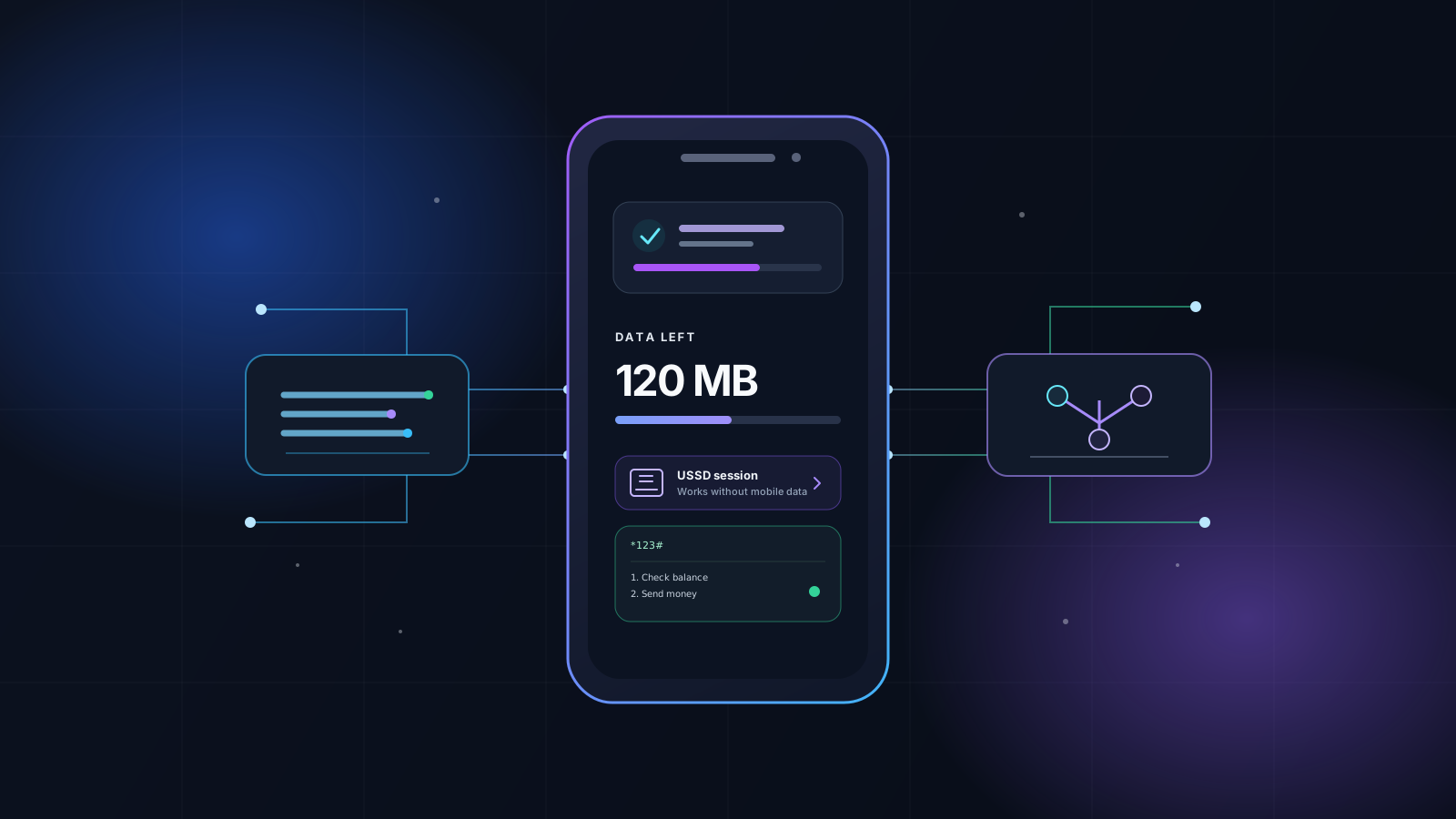
USSD (the *123# style menus) runs on the phone’s basic signalling channel. It does not need a data bundle, a smartphone, or an app install. It works on the cheapest handset a customer owns. That is why mobile money and mobile banking in Zimbabwe have long leaned on it. EcoCash, in particular, has historically processed the large majority of mobile money activity in the country, and USSD access has been central to how people pay bills, buy airtime, and move money.
The cost of USSD sessions has been a policy topic as well. POTRAZ has previously lowered the cap on charges for USSD sessions used for banking, with the stated aim of reducing the cost of electronic payments. Check the current rules and your aggregator’s pricing, because who pays for each session depends on the contract.
Where USSD fits, and where it does not
USSD is excellent for short, structured, transactional tasks: balance checks, payments, registrations, simple lookups, confirmations, and alerts that need a reply. It is poor for anything long, visual, or open-ended. Menus are text-only, screen space is tiny (often around 160 to 182 characters per screen), sessions time out, and deep menus frustrate people. It also offers weak security by itself, so sensitive actions need extra protection such as a PIN and confirmation steps.
A practical channel guide
- USSD: best for payments, short forms, balance or status checks, and reaching feature-phone users. Keep menus shallow, usually three levels at most, and let people go back or restart.
- SMS: best for notifications, reminders, one-time codes, and simple keyword-based services. It works offline from data, but delivery is not guaranteed and messages are short and unencrypted by default.
- WhatsApp: best for conversational support, order-taking, and sharing small documents or images. It is popular and has specific bundles on some networks, but it needs a data connection and a smartphone, and it has policy rules for businesses.
- A lightweight web app or progressive web app: best for richer interaction, accounts, and content, with caching so it keeps working through drops. It needs data, but you control how much.
- A native app: best when you need deep device features. Large downloads and frequent updates are a real cost for people on small bundles, so keep the app small and updates infrequent.
- Voice or IVR: best for people who cannot read well or who use basic phones. It is costlier to run but valuable for health, agriculture, and public information.
Most good services combine channels: a USSD or SMS entry point, a WhatsApp conversation for support, and a lightweight web page for those who want more.
How to build low-data products
Designing for scarce data is mostly about discipline. A few rules of thumb, based on common engineering practice, help.
- Set a weight budget. Decide the maximum size of a first page load, for example a few hundred kilobytes, and treat it like a feature. Measure with throttled network settings and a mid-range Android phone, not your fastest laptop.
- Put text first. Load the words and the main action before decoration. Avoid auto-playing video, large hero images, and heavy animations.
- Compress and resize images. Serve images at the size they are displayed and use modern formats where your audience’s phones support them. Lazy-load anything below the first screen.
- Limit scripts and third parties. Every library, font file, and tracker costs data and battery. Prefer system fonts and plain HTML where possible.
- Cache and work offline. Use service workers and local storage carefully so repeat visits cost almost nothing, and show what is saved versus what is waiting to sync.
- Make requests small and resumable. Send compact responses, compress them, and let uploads and downloads resume after a drop instead of starting again.
- Preserve user input. Never lose a long form because the connection dropped. Save drafts and show clear pending and failed states.
- Offer a data-saver mode. Let users turn off images, video, and auto-refresh, and show approximate data use before big downloads.
- Design for small screens and low-end phones. Test on older Android devices with limited memory, and avoid assuming the latest browser features.
- Add a fallback. If the web app fails, give a USSD, SMS, or phone number route for the essential task.
Designing a good USSD flow
- Open with the most common task first, not a long welcome message.
- Use short, numbered options and plain language, in the languages your users speak.
- Confirm money and identity steps clearly, and show the amount and recipient before charging.
- Allow people to go back and to exit without losing everything, and handle timeouts gracefully by sending an SMS summary or a way to resume.
- Test on real networks. USSD behaviour can differ between operators and across times of day.
Data protection does not stop at the USSD menu
Low-data does not mean low-responsibility. A USSD or SMS service that collects names, phone numbers, national ID numbers, health information, or payment details is processing personal data. Zimbabwe’s Cyber and Data Protection Act applies, and POTRAZ began mandatory inspections of organisations that process personal data from 1 September 2026. Depending on your scale, you may need to be licensed as a data controller and to appoint a Data Protection Officer.
In practice, that means collecting only what you need, explaining why you are collecting it in plain language (even within the limits of a short USSD screen, with a longer notice by SMS or on a web page), protecting stored data, limiting who can see it, and having a plan for breaches. If you use an aggregator, a cloud provider, or an AI service, they are processors handling data for you, so check their terms and your contracts. Confirm your obligations with POTRAZ or a qualified adviser.
Practical tips for people on a tight data budget
- Turn on data saver in your phone and in browsers and apps that offer it.
- Disable auto-download of photos, videos, and documents in messaging apps, and turn off automatic app updates on mobile data.
- Update and download on Wi-Fi at home, school, work, or a digital centre when you can.
- Use lite versions of apps where available, and remove apps you rarely use because background activity consumes data.
- Check which bundle fits the task. Some networks offer app-specific or time-limited bundles that can be cheaper for messaging or study, but terms and prices change, so read them before you buy.
- Download maps, documents, and study material for offline use when connected, so you do not stream them repeatedly.
- Monitor usage. Use your phone’s data usage screen to find out which apps use the most, and set a warning limit.
- Prefer text and audio over video when you can, since video is usually the biggest consumer of data.
What to watch in 2027
These are informed expectations, not guarantees.
- Tariff and cost debates will continue. Operators are under cost pressure, and consumers and civil society are pushing for affordability. Watch POTRAZ tariff approvals and quarterly sector reports.
- Satellite will keep expanding access, especially for schools, clinics, and businesses outside fibre areas, though subscription cost and power will remain limits.
- Heavier applications will test networks. If traffic keeps growing much faster than new subscribers, operators will need more fibre, 5G, and international capacity, and quality could vary by location and time.
- AI services will widen the gap or help close it. Cloud AI tools use data and require good connectivity, so lightweight, text-first, or on-device approaches and local-language support will matter.
- USSD and SMS will not disappear. They will increasingly sit alongside WhatsApp and web channels, with stronger security and better user experience.
- Digital skills and power will decide results. Access programmes work best when paired with training, devices, and reliable electricity.
The bottom line
Zimbabwe is more connected than it has ever been, and that progress is real. But a connection on paper is not the same as affordable, reliable, everyday use. For the next several years, the winning products will be the ones that respect how people actually connect: small, fast, text-first, resilient to drops, available through USSD or SMS where it counts, and careful with personal data.
If you build, set a data budget and test on a slow connection. If you run an organisation, offer more than one channel. If you are a user, learn your phone’s data tools and choose bundles that match your needs. And if you shape policy, keep affordability, coverage, and power on the same table as the headline penetration figure.
Note: figures are drawn from public reports available in October 2026, including POTRAZ sector reports as summarised in the media, MISA Zimbabwe analysis, and industry coverage. Tariffs, coverage, and policies change often, so confirm current details with your network operator, POTRAZ, or the relevant authority.